Collapse-Induced Excitation Redistribution
and Entropy Structuring in
Fully Connected Qubit Networks
Abstract
We study a 16-qubit system prepared as a uniform superposition over all computational basis states with total Hamming weight ≥ 8. An all-to-all controlled-Z (CZ) layer, being diagonal in the computational basis, leaves Z-basis populations unchanged. Measurement of eight qubits in the Z basis and post-selection by their Hamming weight r produces a strict excitation–entropy trade-off on the remaining eight qubits:
r = 0 deterministically yields |11111111⟩ (Eq = 1, zero entropy).
r = 8 yields a maximally mixed distribution (Eq = 0.5, eight bits of entropy).
A complementary interference variant — adding Hadamard gates on the unmeasured qubits before readout — reveals phase-sensitive deviations from the classical curve, confirming the quantum origin of the correlations.
Read paper PDFFigures
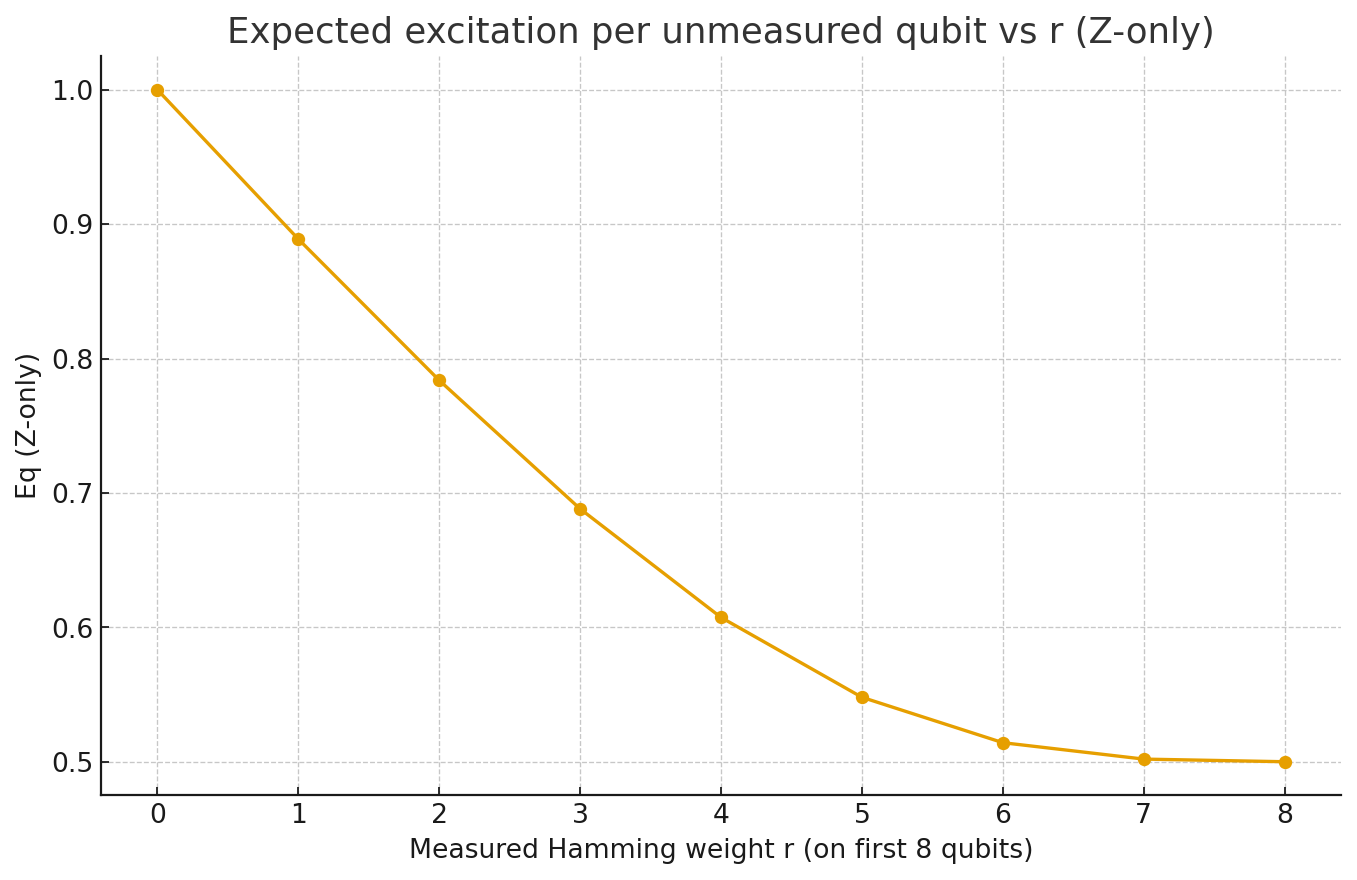
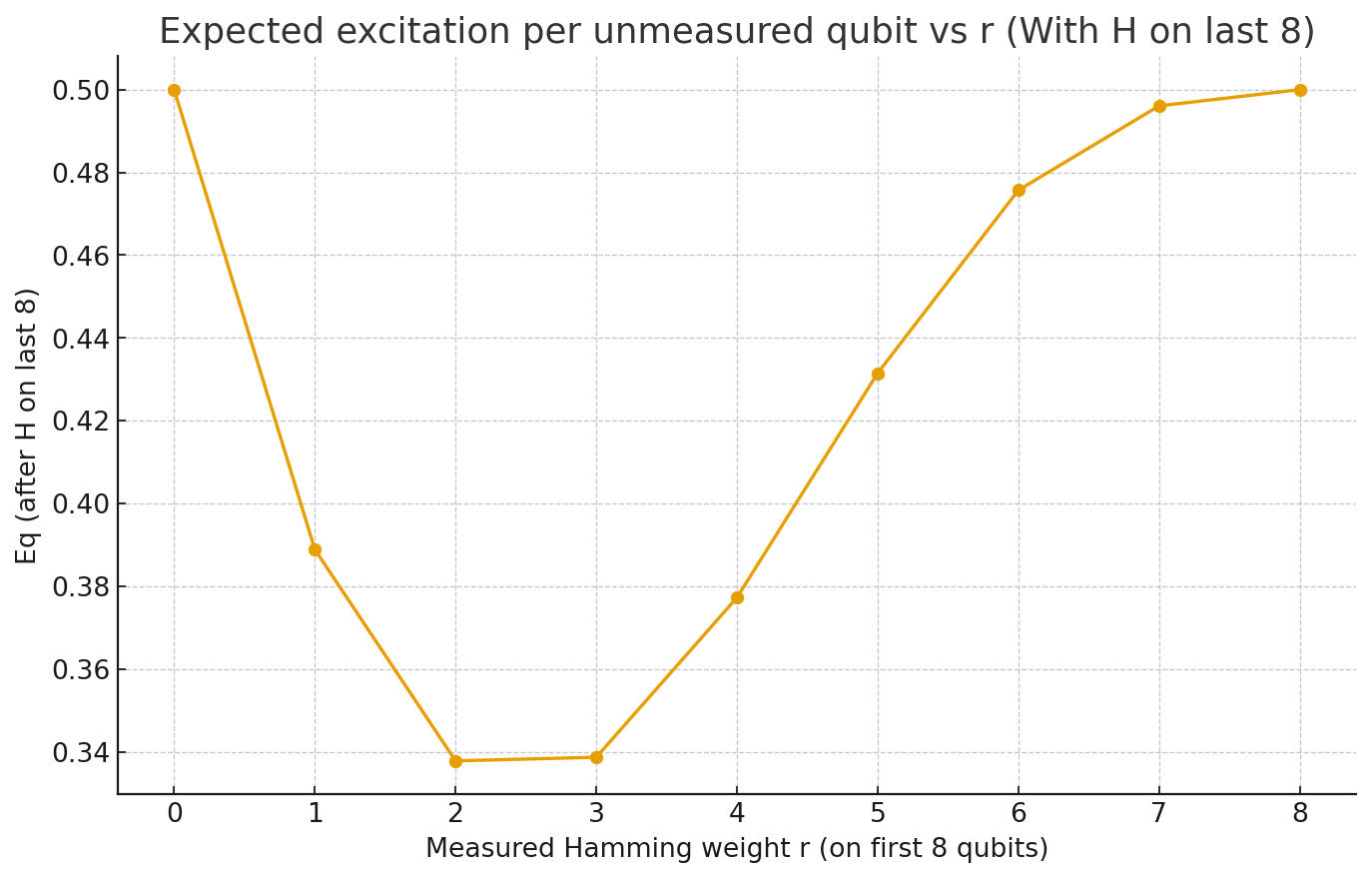
Per-qubit excitation (Eq) vs measurement outcome r
Z-only full data
Interference full data
Setup
python3 -m venv venv && source venv/bin/activate
pip install numpy pandas matplotlib reportlab
python code/v4cg.py --z-only
python code/v4cg.py --interfere
Outputs written to data/ and paper/ as CSV and PNG.
Method
1. State preparation: uniform superposition of all 16-bit strings with Hamming weight ≥ 8 (39,203 states).
2. Entangling layer: all-to-all CZ (120 gates, diagonal in computational basis).
3. Measurement: first 8 qubits in Z basis, conditioned on Hamming weight r.
4. Metrics: excitation E, per-qubit Eq, marginal entropy H_marg, joint entropy H_joint, multi-information I = H_marg − H_joint.
5. Interference extension: apply H⊗⁸ on unmeasured qubits before readout to expose CZ-phase effects.